
Which market segments create sustainable value, and which create volume only?
S&P · Market & Competitive Intelligence
Markets are not won in spreadsheets.
Decisions require more than market size and growth rates. What matters are the mechanisms behind adoption, access, differentiation, investment, competitive response, and customer behavior.
Executive Stakeholder Intelligence
When the critical evidence sits in expert judgment
S&P can complement market and competitive analysis with deliberately selected expert interviews or an executive advisory board — as a stand-alone pilot or as the first layer of a broader market-analytics mandate.
Explore the focused intelligence approachMarket & Competitive Intelligence
Decision questions beyond market size
Which competitors influence standards, perception, and access?
Which unmet needs matter, and to whom?
Which stakeholders decide, influence, or block adoption?
How robust are the forecast, positioning, and resource assumptions?
Competitive position becomes visible criterion by criterion
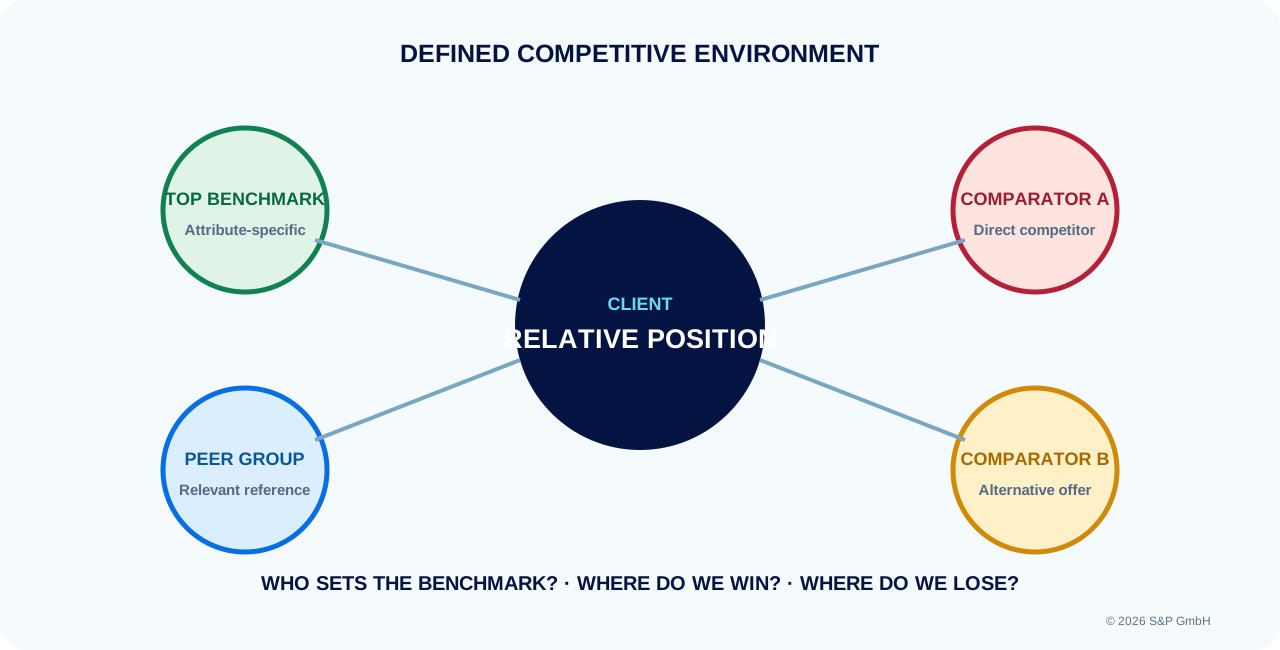
Market position is relative: a company can improve and still lose if relevant competitors move faster or define the top benchmark.
The client, comparators, peer group, and benchmark are therefore compared across decision-relevant criteria rather than hidden behind an average.
What the figure means for management
This creates a pattern of strengths, deficits, and competitive priorities. Management receives more than a score: it gains a robust basis for differentiated decisions.
Concrete S&P contribution
S&P defines the relevant competitive environment, validates the comparison criteria, and prioritises action by gap, strategic relevance, interdependence, and feasibility.
Market & Competitive Intelligence
Methods follow the decision
Depending on the question, we combine desk research, secondary data, expert and stakeholder interviews, qualitative and quantitative research, competitive and technology assessments, perception analyses, scenarios, and opportunity and risk assessments.
Principle
Methods follow the decision. They are not sold as a standardized package.
Market & Competitive IntelligenceDiscuss a market or competitive situation
The interpreted decision space
The result is an interpreted decision space: relevant market mechanisms, reliable benchmarks, prioritized opportunities and risks, uncertainties, implications, and concrete next steps.